I haven't been writing much lately, obviously. As I'm sure all of you know, there are ups and downs in this world of food allergies and, despite all the news being good for us, the stress of introducing all these new foods has made spring a stressful time in our house.
But I thought of you all two mornings ago. That is, I thought of you all after my heart stopped racing and the nausea and shakes went away.
Monday morning, my daughter (the one we called "Teflon girl" because illness seems to just slide off her) came into the office where I was working. She had just gotten out of bed. She said "Mom, I feel so sick I don't know what to do" and slumped against my shoulder.
I thought she was kidding until I reached out and touched her. Ice cold. Covered in sweat. And losing consciousness.
She got up off the chair and lurched toward her bedroom. I followed her, heart in my mouth, just in time to see her fall full out across her bed, lengthwise. As I ran to her and shook her (no response, eyes wide open), I thought to myself "This cannot be happening. This CANNOT be happening! This is the one who doesn't HAVE medical issues!"
Fifteen seconds of shaking and calling her name - no response. I ran for the office phone and dialed 911. "I need an ambulance!" tumbled out, followed by our address, her symptoms. Yes, she was breathing. No, she wasn't responsive. No, she did not have a history of seizure disorders. More questions I don't remember. Why are they talking to me while my daughter is laying here? Why aren't they on their way?
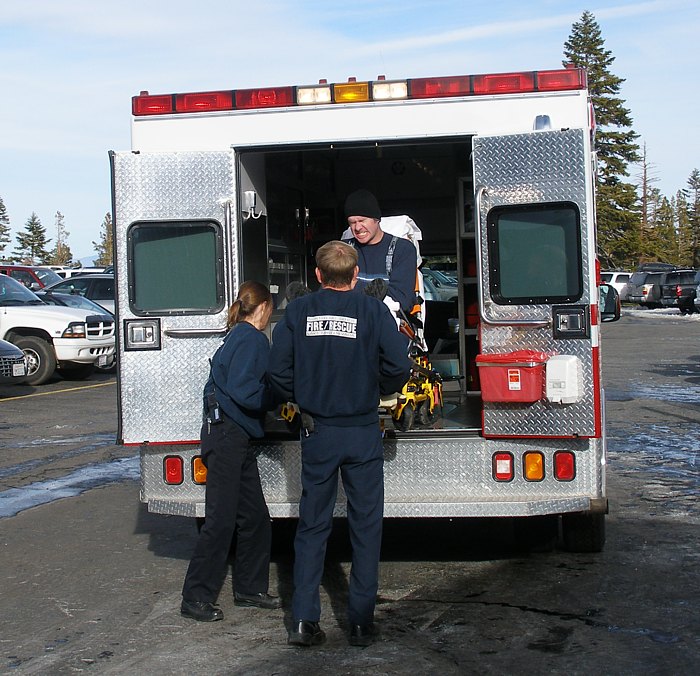
Just then, she regained consciousness. "I'm o.k., Mom," she said. "You don't need to have them come." But they were already on their way, and I sure as heck wasn't going to tell them not to come after what I had just been through.
What I had just been through. My daughter, as it turned out, was probably going to be o.k. The EMTs did come (seemed like forever, probably only took them 5 minutes though) and checked her out. All vitals were fine. She felt fine.
When we went to the doctor later on in the day, he said she probably had a stomach virus and simply fainted. Apparently it happens a lot to teenage girls.
But there were also a series of questions from him. Any history of sudden death in the family? (Turns out cardiac disorders can manifest with fainting episodes.) Any history of familial fainting? I reminded him of her bone marrow disorder when she was a toddler...could this be related? "No," he replied, "although I'll be happy to run a hemoglobin test if it would reassure you. But I can tell from looking at her that her iron and red blood cell count are fine."
He went on to say that, 99% of the time, fainting is just a simple nervous system reaction. There's no real way to know which kids are going to have a more serious underlying cause, however, without a bunch of testing. They prefer not to do all that testing unless there are multiple episodes.
I found myself looking at my daughter in a whole new way on the way home. My Teflon girl was all of a sudden...fragile. I couldn't sleep all Monday night. I kept going into her room to make sure she was o.k., as if my presence could magically hold back another episode.
Does all this sound familiar?
Honestly, I don't know how we do it all day, every day. The idea that a seemingly healthy child could just keel over is horrific. Living in the what if it happens again world every day is even worse.
Why is it so hard to live in the moment? To simply enjoy our children without treating them like ticking time bombs? Why is it so hard to talk about the stress of medical issues with others without sounding crazy or feeling judged?
How do you shake the fear, once it's in your house? In your heart?
I don't know. I wish I did. All I can do is write about it.
Follow me on Facebook or Twitter
Showing posts with label food allergy stress. Show all posts
Wednesday, July 3, 2013
Tuesday, July 24, 2012
Walking the Street of Imaginary Grief
I really don't want to write about Aurora. But...I also haven't been able to write or think about anything else since the shooting. It cuts a little close to home for me, literally, as I lived about five blocks from both the killer's apartment and the movie theater after I graduated from college. I've thought about why that even matters to me, 25 years later, and the answer is simple: all tragedies are about me.
It's human nature to personalize it all. We see ourselves in the shoes of the victim (and maybe even a little in the shoes of the killer, based on the amount of speculation about why he would do this). It's just a little easier in this case for me to put myself in those shoes because I actually walked those streets.
My guess, though, is that you ALL are putting yourselves in those shoes, way more, perhaps, than other mothers are right now. And, again, the reason is simple — you've walked those streets. Not the streets of Denver around the med center, but the streets in your mind of having a child suddenly, senselessly, taken from you.
Does it do any good to walk those streets? Does it somehow keep our children safer to envision them dead? Do we try harder as a result, perhaps, to keep them safe? The answer, of course, is no. And yet, we all walk down foggy Whatif Avenue way too much.
My mother is a clinical psychologist, so I have a built-in go-to resource for this type of thing. She says the trick is to recognize when the negative thinking is occurring and then to re-frame it to a more positive thought. In other words, when you find yourself daydreaming about your child dying from an allergy, STOP the thought and substitute whatever works for you:
It's human nature to personalize it all. We see ourselves in the shoes of the victim (and maybe even a little in the shoes of the killer, based on the amount of speculation about why he would do this). It's just a little easier in this case for me to put myself in those shoes because I actually walked those streets.
My guess, though, is that you ALL are putting yourselves in those shoes, way more, perhaps, than other mothers are right now. And, again, the reason is simple — you've walked those streets. Not the streets of Denver around the med center, but the streets in your mind of having a child suddenly, senselessly, taken from you.
Does it do any good to walk those streets? Does it somehow keep our children safer to envision them dead? Do we try harder as a result, perhaps, to keep them safe? The answer, of course, is no. And yet, we all walk down foggy Whatif Avenue way too much.
My mother is a clinical psychologist, so I have a built-in go-to resource for this type of thing. She says the trick is to recognize when the negative thinking is occurring and then to re-frame it to a more positive thought. In other words, when you find yourself daydreaming about your child dying from an allergy, STOP the thought and substitute whatever works for you:
- I've taken every precaution and trained him well, so the likelihood of him dying is extremely small
- Most children do not die from anaphylaxis, even in situations when it's left untreated
- Only a handful of kids die each year, and the vast majority of them did not have epinephrine with them
Or, simply, "my child will not die."
No parent wants to think about death. But thinking about it all the time is like a little death, again and again. It doesn't make us more prepared, should the worst occur. It just makes us afraid, and therefore less able to cope in an emergency.
We're surrounded by negative stories. Negative stories build web site traffic. But there's a huge irony in living in a world that is the safest it's ever been, with technology like an Epi-Pen that can save lives, yet being more afraid than past generations. Our movies are filled with shootings and deadly viruses and global warming catastrophes. Our fiction (especially our children's fiction) is increasingly dystopic.
I don't know what motivated this man to kill so many, but I do know the line between fiction and reality was awfully blurry for him. It's not realistic to only watch re-runs of The Waltons...but maybe a little less Contagion and 24-hour news would help.
All of us will have cause to grieve at some point in our lives, so in that respect, we are the same as the Aurora families. However, there will be time enough for grieving when the day comes. We know we're especially vulnerable, so that's all the more reason to protect ourselves emotionally.
Follow me on Facebook or Twitter We're surrounded by negative stories. Negative stories build web site traffic. But there's a huge irony in living in a world that is the safest it's ever been, with technology like an Epi-Pen that can save lives, yet being more afraid than past generations. Our movies are filled with shootings and deadly viruses and global warming catastrophes. Our fiction (especially our children's fiction) is increasingly dystopic.
I don't know what motivated this man to kill so many, but I do know the line between fiction and reality was awfully blurry for him. It's not realistic to only watch re-runs of The Waltons...but maybe a little less Contagion and 24-hour news would help.
It's these little things, they can pull you under
Live your life filled with joy and thunder
Yeah, yeah, we were altogether
Lost in our little lives
Live your life filled with joy and thunder
Yeah, yeah, we were altogether
Lost in our little lives
All of us will have cause to grieve at some point in our lives, so in that respect, we are the same as the Aurora families. However, there will be time enough for grieving when the day comes. We know we're especially vulnerable, so that's all the more reason to protect ourselves emotionally.
Monday, April 16, 2012
All I'm Missing Is The Buggy
There are days when I think the closest thing to living with food allergies is living as a member of the Amish community.
Other people really just don't get us. The cooking. All the cooking. The obsessive search for recipes. The crazy avoidance rules. The eating out only on special occasions in a handful (if we're lucky) of trusted places.
When a friend of mine heard how much we cook and how little we eat out, she was horrified. "We order in EVERY NIGHT!" she exclaimed. Now, granted, she's at the extreme end of a very economically-privileged bubble. But the message wasn't lost on me: real Americans do not cook any more.
Our kids can seem overprotected and antisocial, even when they're not. My son does go along with his friends to the various restaurants in town at times, but there are times when he'll also stay home. "It makes them uncomfortable when I just watch them eat," he tells me. Sometimes he's just not up for ordering the Coke and trying not to stare.
I know what he means when it comes to social avoidance. There's no way to fly under the radar; showing up with unsolicited food for just your child always required explanation. If I do it without warning, people are offended. If I try to explain before the party, the host usually will want to try to make something safe...and try is the operative word. Years back, I used to attempt the crash course in kitchen cross-contamination, label reading, substitutions. Now I know better. There's just no way to explain it without opening up that wide cultural gap and I'm tired of people looking at me like I'm wearing a Quaker cap. Far easier to just beg off from social events that involve meals.
Our tribe is so very important in life. There's nothing worse than feeling isolated from, or even shunned by, those who should understand what we need. It's easy to start to think of ourselves as a group apart.
The problem is that we don't live in a community of individuals dealing with the same issues like the Amish do. Our food-allergy connections are mostly virtual ones. It's great to learn on a chat board that applesauce subs for egg, but that doesn't help with the grind of making those three meals and after-school snack every day. Plus, these ties are surprisingly tenuous. It's easy to chat on-line with someone for years and then, when you finally meet in person, get a completely difference sense for who they are. Face-to-face interaction trumps the internet every time.
Respite care is also a huge issue. For most of us, there are only a few people who really understand food allergies. What do we do when those people aren't available, especially in an emergency? Even in the everyday, food allergies take a toll. Date night can be a difficult goal when a trained, adult sitter is required. And those elusive weekends away? Unfathomable for the food-allergic parent. Yet emergency backups, date nights and weekends away are necessary if we are to keep our stress levels low and our marriages together.
If we identify too much with the "tribe" of food allergies, it's easy to see people who would genuinely help us as hostile outsiders. "It's hard to make them understand" can quickly become "they really don't want to understand or help."
I know I need to do a better job of asking for support. It takes a village to raise both a barn and a kid, as the sayings go. Time to hitch up my buggy and mingle among the English.
Other people really just don't get us. The cooking. All the cooking. The obsessive search for recipes. The crazy avoidance rules. The eating out only on special occasions in a handful (if we're lucky) of trusted places.
When a friend of mine heard how much we cook and how little we eat out, she was horrified. "We order in EVERY NIGHT!" she exclaimed. Now, granted, she's at the extreme end of a very economically-privileged bubble. But the message wasn't lost on me: real Americans do not cook any more.
Our kids can seem overprotected and antisocial, even when they're not. My son does go along with his friends to the various restaurants in town at times, but there are times when he'll also stay home. "It makes them uncomfortable when I just watch them eat," he tells me. Sometimes he's just not up for ordering the Coke and trying not to stare.
I know what he means when it comes to social avoidance. There's no way to fly under the radar; showing up with unsolicited food for just your child always required explanation. If I do it without warning, people are offended. If I try to explain before the party, the host usually will want to try to make something safe...and try is the operative word. Years back, I used to attempt the crash course in kitchen cross-contamination, label reading, substitutions. Now I know better. There's just no way to explain it without opening up that wide cultural gap and I'm tired of people looking at me like I'm wearing a Quaker cap. Far easier to just beg off from social events that involve meals.
Our tribe is so very important in life. There's nothing worse than feeling isolated from, or even shunned by, those who should understand what we need. It's easy to start to think of ourselves as a group apart.
The problem is that we don't live in a community of individuals dealing with the same issues like the Amish do. Our food-allergy connections are mostly virtual ones. It's great to learn on a chat board that applesauce subs for egg, but that doesn't help with the grind of making those three meals and after-school snack every day. Plus, these ties are surprisingly tenuous. It's easy to chat on-line with someone for years and then, when you finally meet in person, get a completely difference sense for who they are. Face-to-face interaction trumps the internet every time.
Respite care is also a huge issue. For most of us, there are only a few people who really understand food allergies. What do we do when those people aren't available, especially in an emergency? Even in the everyday, food allergies take a toll. Date night can be a difficult goal when a trained, adult sitter is required. And those elusive weekends away? Unfathomable for the food-allergic parent. Yet emergency backups, date nights and weekends away are necessary if we are to keep our stress levels low and our marriages together.
If we identify too much with the "tribe" of food allergies, it's easy to see people who would genuinely help us as hostile outsiders. "It's hard to make them understand" can quickly become "they really don't want to understand or help."
I know I need to do a better job of asking for support. It takes a village to raise both a barn and a kid, as the sayings go. Time to hitch up my buggy and mingle among the English.
Tuesday, March 20, 2012
My Perfect Comfort Zone
I'm a bitch. I admit it. (It's right up there in the masthead if you look.)
When it comes to food allergies, I seem to have a little judging voice in the back of my head. The one that says things like:
You see, I have a perfect comfort zone. I know everything there is to know about allergies. Don't you?
Some of the cruelest comments I've ever heard about food allergies have come from other mothers with food-allergic children. When our comfort zone is threatened, man, the claws come out! So why do we do it?
I think it's because we believe our comfort zone sits smack between two really untenable options:
We have to believe that our unique set of precautions will be in that magical middle ground. It's also natural that we would defend that middle ground, since the stakes are so high.
To complicate things, there are a LOT of people in the world who think they have an IgE-mediated food allergy, but who do not. There's no gold standard to tease out these people. Even allergists can have difficulty diagnosing some allergies, and cell-mediated intolerances can be very debilitating.
It matters because people take food allergies less seriously when the community is full of perceived "fakers." On the other hand, because we all have different needs, symptoms, triggers and thresholds, we can all look like fakers to someone else whose formative experiences have been different than ours.
In the end, it's easy to end up lonely, even surrounded by other parents of children with allergies. Their flavor of allergic response can be so different that it's hard to find common ground. Contact reactions or just ingestion. Hives or no hives. Single allergens vs. a host of allergens. Exquisite trigger threshold vs. no problem with minor cross-contamination. Each of these responses changes completely the choices we make to deal with our kids and the world around them. There are millions of children with food allergies, yet each of them has a unique condition.
I hope I'm becoming less judgmental as I move through this journey. It's easier to let go of judgment when I acknowledge the fear that's behind it. And, for those days when I run into a parent who's actually bitchier than me, I keep a little sign around:
What's the nastiest thing someone's ever said to you? Add it to the comments!
Follow me on Facebook for updates!
When it comes to food allergies, I seem to have a little judging voice in the back of my head. The one that says things like:
Are you KIDDING me? The kid has 20 allergies? That cannot be possible.
Four episodes of anaphylaxis this year? Clearly they're using that Epi-Pen for panic attacks.
You're not going to let your kid go to a birthday party? Are you going to keep him away from the supermarket, school and the workplace too?
Anaphylaxis to airborne peanuts on an airplane? Really?
You see, I have a perfect comfort zone. I know everything there is to know about allergies. Don't you?
Some of the cruelest comments I've ever heard about food allergies have come from other mothers with food-allergic children. When our comfort zone is threatened, man, the claws come out! So why do we do it?
I think it's because we believe our comfort zone sits smack between two really untenable options:
We have to believe that our unique set of precautions will be in that magical middle ground. It's also natural that we would defend that middle ground, since the stakes are so high.
To complicate things, there are a LOT of people in the world who think they have an IgE-mediated food allergy, but who do not. There's no gold standard to tease out these people. Even allergists can have difficulty diagnosing some allergies, and cell-mediated intolerances can be very debilitating.
It matters because people take food allergies less seriously when the community is full of perceived "fakers." On the other hand, because we all have different needs, symptoms, triggers and thresholds, we can all look like fakers to someone else whose formative experiences have been different than ours.
In the end, it's easy to end up lonely, even surrounded by other parents of children with allergies. Their flavor of allergic response can be so different that it's hard to find common ground. Contact reactions or just ingestion. Hives or no hives. Single allergens vs. a host of allergens. Exquisite trigger threshold vs. no problem with minor cross-contamination. Each of these responses changes completely the choices we make to deal with our kids and the world around them. There are millions of children with food allergies, yet each of them has a unique condition.
I hope I'm becoming less judgmental as I move through this journey. It's easier to let go of judgment when I acknowledge the fear that's behind it. And, for those days when I run into a parent who's actually bitchier than me, I keep a little sign around:
What's the nastiest thing someone's ever said to you? Add it to the comments!
Follow me on Facebook for updates!
Subscribe to:
Posts (Atom)