Wednesday, November 20, 2013

Best Food Allergy Tweets/Posts From 2013 ACAAI Meeting

Sorry, guys...I've been very busy the last couple of weeks, but just over a week ago one of the largest allergy and asthma conferences, the annual American College of Allergy, Asthma and Immunology, was tweeting its brains out.

Here were the tweets and (virtual) presentations I thought were most interesting:

ACE inhibitors are often used to treat high blood pressure. I believe Lisinopril was the one specifically mentioned. This goes hand in hand with the idea that older patients, especially men, can see changes in the severity of their allergic reactions as they age.

Here's an answer on the question many of us asked about component testing. Just as with RAST, the number itself doesn't matter; just the positive result.

Gross! But yes, give your kids the bobber after the dog/ brother/ mailman licked it.

Conversely, tree-nut-allergic individuals have a 30% incidence of concurrent peanut allergy. 

So stop blaming yourselves, FA mommies! I've said this consistently - Mother Nature would not rig the game so babies needed to be given certain foods at certain times. Our existence on this earth has been too precarious to count on that type of consistency. 

Part two of STOP BLAMING YOURSELF! It doesn't matter what you ate. It doesn't matter what you fed your baby. We don't know how sensitization happens, but it doesn't seem to be through the food itself.

Other summaries and presentations you might like:
If you only read one, read that last one.

Happy Wednesday!

Follow me on Facebook or Twitter  

Sunday, November 17, 2013

Magical Thinking and Food Allergies

So we got our FAHF-2 clinical trial email notification this week.

No, it's not the trial results. It was just a brief little note:
We are pleased to let you know that study participants have completed all study visits and we are now able to inform you of which treatment arm you or your child were part of (active or placebo).
[FAB's kid] was on active treatment medication.
At this time we can only provide you with your treatment assignment.  We are unable to share any information pertaining to other study participants.  Once the data is fully analyzed and peer reviewed, we will be able to share the overall study results. 
So...good. We weren't crazy.

The problem is that history is always written after the fact. While you're living your way through something, cause and effect are never clear. When people ask us whether the medication has made all the difference in my son's life, I have to just shrug and say "I don't know." There HAVE been some major changes since last winter:
  • He's now eating all soy (including soy cheese) without restriction. 
  • He's eating baked milk in everything without issue. (The only thing preventing us from introducing baked cheese is our own fear and busy schedules.) 
  • While I know some of you really do not like the concept, he is eating "may contain" for peanut without any issues at all, which has significantly increased the number of processed foods available to him, especially chocolate. 
  • He's started to expand his list of restaurants. While we're still not at the point (and probably will never be) where he can just eat something without asking about it, we no longer worry about cross-contamination.
What we don't know is whether we can attribute all that change to the medication. Is it possible that he had already outgrown soy, that he would have tolerated baked milk at this level without the medication, that "may contain" was always o.k. for him, and that we overreacted when it came to restaurants and cross-contamination?

Of course it's possible. Perhaps even likely. 

On the other had, we did see a measurable, really significant change in his tolerance to peanut. It is just as possible that the process that created that new tolerance also affected his response to these other allergens. But we'll really never know for sure, because the other allergens were not measured as part of the trial. 

It's so easy to see how food-allergy families can have such a diverse approach. The actual evidence we have for severity and tolerance may consist of a single reaction when our child was very young. In the years that follow, some people choose to believe their child's allergy has magically disappeared. Others may re-write it as a completely out-of-control, always life-threatening monster.  Our doctors know nothing. We know next-to-nothing. But, being human, we make up stories to fill the gap. 

Thanksgiving is just around the corner again. The spread of food always prompts the inevitable questions: 

How are his allergies? Did the study cure him? Can he eat what I brought now? Will he be able to take the medication again? Do you want him to do it if he can? Was it worth it? Do you think it worked? Will it work for others? 

Our family will be challenged to write the story that goes with this clinical trial. People really hate the very short story we've told up until now: we just don't know.

Everyone wants a definitive ending...even if we have to make it up. It's human nature. 

Follow me on Facebook or Twitter  

Sunday, November 3, 2013

Inclusion and Food Allergies: How Far Is Too Far?

I enjoy hanging out on Reddit. It feels a little like going to a teenager zoo and I consider it an important study tool in the quest to understand my own teens. Yes, there are other people there who are 40+, but for the most part, Reddit is a collection of teens and 20-somethings with too much time on their hands and often a Lord of the Flies mentality.

So I was not all that surprised to run across this one:


The original poster went on to say:
I was the only one in the neighborhood giving out small goodie bags of bite size butterfingers, recesses peanut butter cups,starbursts and other assorted chocolates during halloween. This woman comes back to my house and got angry at me for giving her son candy with peanut butter in it. He ate some and he was having an allergic reaction. How the hell am i suppose to know what her son is allergic to. It wouldn't kill her to be a good parent and monitor what her kid eats instead of blaming me.
I read through some of the almost 2000 comments, trying to keep my anger in check. The oldie but goodies were all there:

"if touching a nut kills you, you’re supposed to die"

"I went to elementary school in the 1960's. I don't remember anyone having any issue at all with foods."

"Your niece might need to be homeschooled..."


Don't get me wrong: I think the mom who did this made a big mistake. I do understand; in the panic of the moment, I have done some crazy things, including calling a food manufacturer in the middle of a reaction to ask about the ingredients.  But suddenly, I had a small moment of insight of how that Roma family in Ireland might have felt after the police took away their child because she looked too blond to really belong to them. Just because one person in your community does something questionable, does that make it o.k. for the rest of society to pour out their hate on all members? Where does all this hate come from?

No, it's not o.k. that the mom blamed the neighbor for her child's reaction. But it's really not o.k. that so many people are willing to jump on the hate bandwagon as a result.

My Reddit comments to that effect were just drops in the ocean, and I suspect a larger response would only make us look crazy. What is the answer? How do we combat this prejudice without seeming over-reactive?

Follow me on Facebook or Twitter  

Saturday, October 12, 2013

Discuss This Food Allergy Research At The Dinner Table Tonight!

FARE's name change ruined
my awesome pun headline
My mom and I went to a reunion this summer with her first cousins, ladies I had not met before. On the way to the restaurant, I was telling my mom about my summer research into intestinal flora and fecal transplant.

The poop had definitely been circulating in the news all summer, with the popular science journals joining in:
We ran into the cousins in the parking lot and introductions and hugs were passed around. Just as I'm opening the door to the restaurant, my mom says "so FAB, tell my cousins what you were just telling me about transferring pooh into people's colons." 

Not the ideal way to be introduced. 

But you can see the difficulty. This is an astonishing new area of exploration in science...and just not great dinner conversation. I'm going to plunge ahead anyway, but be forewarned that you might want to put your snack down before reading further. 

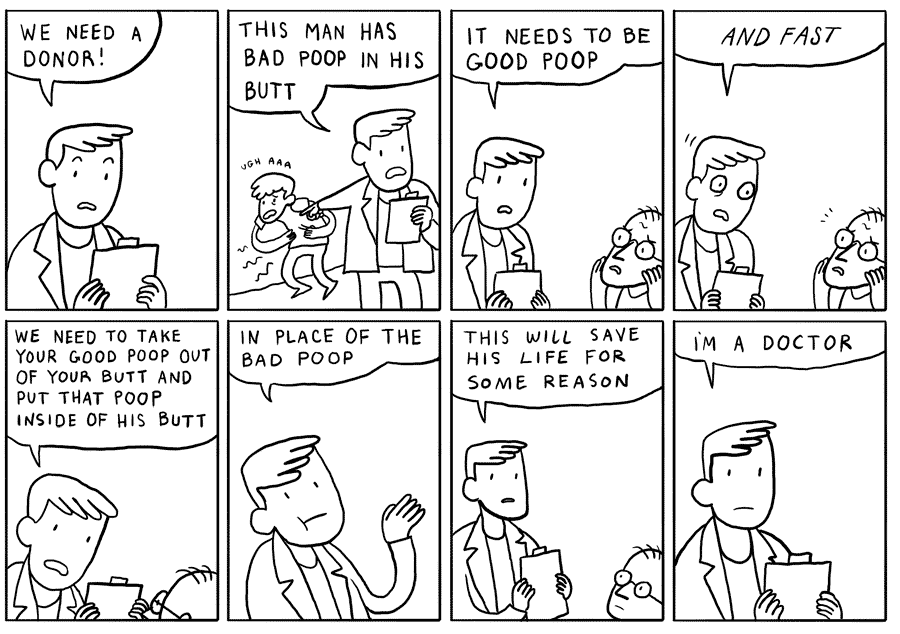
Here's a cartoon to get us started:

From Three Word Phrase - very funny guy!
I first encountered fecal transplant in the literature as part of my day job. It has been extraordinarily successful in treating C. difficile, an often hospital-acquired infection that can ravage its victims. 

If simply transplanting poop from a healthy person into a compromised person can have such amazing results, then why not for other conditions that involve the gut, like food allergies? 

The science of all this is daunting. The human gut contains as many as 100 trillion separate types of bacteria, which is why I always giggle a bit when people talk about "probiotics" as a treatment for food allergies. Typical probiotic supplements contain only the bacteria we can grow outside the body:  usually one of only FIFTEEN strains.
It's a bit like throwing dye into the ocean in the hopes of coloring it red. 

Scientists are working on categorizing these bacteria. One of the more notable efforts going on right now is called the American Gut Project.  That project has already demonstrated that the gut bacteria of older vs. younger Americans, and of Americans vs. less developed countries, are vastly different. All of this comes together very well with the Hygiene Hypothesis II, which says that our decimation of gut bacteria through the use of antibacterials (including triclosan, which I've called the smoking gun for development of food allergies) is at the heart of the rise in intestinal and autoimmune disorders. Even the connection to pets and reduced food allergies makes sense. When we pet our dogs and cats and they, in turn, lick us, different types of bacteria are transferred into our bodies via the skin. Families with pets have different gut bacteria than families without.  

As with everything I read, I am extremely impatient to just cut to the chase. If fecal transplant has the potential to mitigate food allergies, where do we sign up? 

At the moment, fecal transplant is only officially being performed in teaching hospitals, and these facilities are starting to look over their shoulders. Right now, this is an unregulated treatment and the FDA seems to want in on the action. 

On the other hand, if you are adventurous, you can DIY with this helpful Youtube video:


So...all I need is a blender, a way to knock my child senseless so he doesn't know what's about to occur, and a donor! Preferably someone older, whose gut bacteria were colonized before the introduction of antibiotics and the advent of infant formula. Someone in excellent health with an appropriate body weight, who has used only limited antibiotics over the course of their life. 

Gonna see my father-in-law later today. Any suggestions on how to open that topic of conversation? 

Or...maybe I should hold out for the poop pill. At least I could still look my father-in-law in the eye, come Thanksgiving. 

Follow me on Facebook or Twitter  

Sunday, October 6, 2013

Examples of Food Allergy Backlash

I've been pretty busy over the last couple of weeks. So, instead of writing a long blog post, I think I'll just leave a few things here that I've recently run across.

Stores are increasingly putting signs up about allergens. Not all of them are friendly.
This is from an album entitled "Guess What Mark Is Allergic To." His oh-so-helpful co-workers put these notes on food at work.


Someecards has a card for us now.

From Your Food Allergy Is Not My Problem.

Do you guys feel there's more or less of this kind of stuff happening now?


Follow me on Facebook or Twitter  

Monday, September 23, 2013

Seasonality and Food Allergies

Does it seem to anyone else that the odds of outgrowing a food allergy are a bit of a crap shoot?

The odds seem even, well, odder lately. For example, there's this recent study that seems to promote the idea that kids who strictly avoid are more likely to see resolution of their allergy. What does that even mean, strictly avoid? My son ate next to no processed foods, so I would imagine we were in the "strict avoidance" group. When he was RAST tested as part of the clinical trial, his score was so low he barely qualified. Yet he still reacted to peanut - and now his RAST has climbed back up.

Are peanut challenges as part of these trials a bad idea? If that's the case, though, how does that square with oral immunotherapy and SLIT? What about the kids who are going through the challenges and tolerating peanut? How do doctors ever know when to flip that magical switch from avoid to introduce?

Here's another study of people who outgrew, this time for tree nuts. Some of the kids had experienced severe past reactions, yet they still passed.

Then there was that weird SLIT study earlier in the year, where two of the kids in the placebo group spontaneously saw their peanut allergy resolve. I remember laughing when I got to that section of the write-up. You could tell that the researchers were a little miffed at having to explain the anomaly (and the explanation was basically "hey, we don't know, some kids just outgrow").

Those of us who have kicked theories around for years have hypothesized that there are different types of allergies: some that will be outgrown pretty much no matter what parents or kids do, and those that won't.

But what if there's something altogether different going on here?

I've been fascinated for years by the research that showed kids born in the winter months have a higher incidence of food allergy. This study showed an almost 20% increase in food allergies among fall/winter babies. This one showed an increase of 53%! One hypothesis for this is that when very young babies are exposed to heavy pollen loads, their immune system is more likely to learn to overreact. It's also become pretty clear that Vitamin D is somehow playing a role in this.

Honestly, though, I don't care about any of that. I just want to know how to get my kid to pass food challenges. I'm sure you do as well. So...here's my theory:

What if passing or failing a food challenge depends on the time of year the food challenge is given?

Think about it. If kids are predisposed to develop food allergies based on their month of birth, then perhaps those same factors are still in play when it comes to the waxing and waning of food allergies.

Based on all this, the best time to introduce a new food to the immune system would presumably be January or February. It would be especially effective if the child's Vitamin D level was high at the time, either through a good summer/fall spent playing outside or supplementation.

Our own personal experience does align with this. My son's final clinical trial challenges (the ones where he did well) occurred in October and January; earlier this year, he passed a soy challenge in February. Would he have passed if we had scheduled it in, say, May? Or would his already-overburdened immune system have gone crazy, re-sensitizing him to soy and undoing all our hard work of avoidance?

The uneven results of many of these clinical trials might also be at least partially explained by the periodicity of testing. It would be fascinating to see the results of the last several studies graphed against the months in which challenges occurred.

If your child has passed a food challenge, was it in the winter? If failed, was it in the spring or summer? Leave me a comment! 


Follow me on Facebook or Twitter  

Sunday, September 8, 2013

"Can't You Take a (Food Allergy) Joke?"

Somewhere along the way in this 18 year journey, I lost my sense of humor.

I know this is not news to any of you. After all, the "bitch" is right there in the title.

Still, I'm reminded of the loss every time I look at the web statistics for this blog. The web stats include a list of search terms people use to find my articles. Know what one of my top search phrases is?

"Food allergies are fake."

I also get lots of hits from "food allergies overblown", "food allergies exaggerated", "crazy food allergy moms", "nutty food allergy parent" - you get the idea. Any time I look at my web statistics, I get a little reminder of how much hate is floating around out there for kids with this particular medical condition.

The articles that match those search terms though (like this one) mostly defend food allergy parents. It makes me wonder what the people who find my page that way do next. Do they read the article? Or do they wander off looking for another place on the web where they can hone their hate with other people who believe food allergies are imaginary/a pain in the ass (we know!)/the latest flavor of special snowflake-hood?

If you follow them down the rabbit-hole and challenge them on their hatred, eventually you get some version of "geez, can't you take a joke?" Well, no. Unfortunately, I've forgotten how. Explain to me again how funny it is that my son has to grapple with the logistics and fear that comes from a food allergy...and then, on top of it, has to pretend that the bullying doesn't matter to him.

There are days I think how did we as a community get to this place and I'm absolutely overwhelmed by the thought that it will never get better. Food allergies will be forever polarized and my son will always have to fear that one teacher/waitress/boss who buys into food allergies being fake and therefore is just a little (or a lot) less careful than he or she needs to be to keep my son safe.

Because that's the reality: unless he goes through life eating only food he himself prepares, he will need to trust people. When half the population doesn't believe in food allergies (to the point that people are taking the time to search for phrases like "I HATE FOOD ALLERGY KIDS"), how well-placed is that trust?

There was a great article in Slate a while back about the dangers of loneliness. A phrase jumped out at me:
In terms of human interactions...the key is in the quality, not the quantity of those people. We just need several on whom we can depend and who depend on us in return.
With food allergies, it's all about quantity. It's about every person who touches my son's food, or schedules an event involving food, or who makes a choice to support him (or not). It takes all of them — even the ones who are actively spending their time searching for others who hate food allergy kids as much as they do.

A little further down in the Slate article, I saw this:
When we are lonely, we lose impulse control and engage in what scientists call “social evasion.” We become less concerned with interactions and more concerned with self-preservation. Evolutionary psychologists speculate that loneliness triggers our basic, fight vs. flight survival mechanisms, and we stick to the periphery, away from people we do not know if we can trust.
Ouch. The food allergy periphery. Choosing never to eat out. Choosing to avoid social events that involve food. Choosing not to share information about a food allergy with others because of the fear of ridicule. 

I see the haters. Even when I don't look for them in my blog stats, they're there, in my peripheral vision. Where is the magical line between safety and loneliness? 


Follow me on Facebook or Twitter